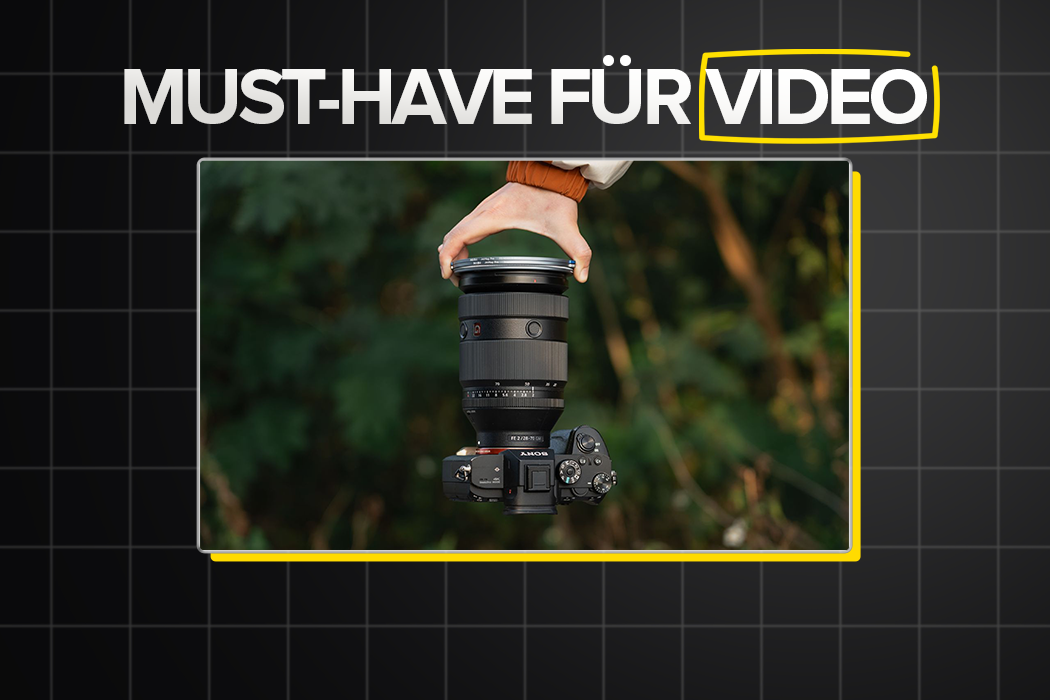
Zoom vs. Prime Lens: Which Is the Better Choice for Outdoor Photography?
Zoom or prime lens? This question is a constant source of debate among photographers. While zoom lenses score points for their flexibility, prime lenses often offer particularly high light intensity. But what really matters in practice?
Especially in outdoor, wildlife, and travel photography, it’s crucial to be able to react quickly to different situations. Together with travel photographer Marcel Lesch, we’ll discuss the strengths and weaknesses of both lens types, when each lens is best suited, and what you should consider when making a purchase decision.


Zoom or Prime Lens—What Are the Differences?
The most obvious difference lies in the focal length. With a zoom lens, you can change the frame without having to constantly move around. A prime lens, on the other hand, offers only a fixed angle of view, but it provides that beautiful bokeh effect that creates a distinctive look. Both types have their advantages:
Zoom Lens
- Flexible thanks to variable focal length
- Fewer lens changes required
- Ideal for changing subjects
- Can replace multiple prime lenses in a single lens
- Often higher maximum aperture
- Often offers particularly good cropping options
- Compact and lightweight, depending on the model
A key factor here is the maximum aperture. Especially in challenging lighting conditions or when you want to isolate your subject against a blurred background, a large aperture can be advantageous. And some zoom lenses may lack precisely this maximum aperture, particularly at longer focal lengths.
However, fixed focal length lenses aren’t inherently faster or sharper than zoom lenses. Modern professional zoom lenses like the Canon RF 28–70mm f/2 or RF 100–300mm f/2.8 demonstrate that high light intensity and flexibility can certainly be combined.

Wildlife Photography: When Flexibility Is Key
In wildlife photography, it’s often impossible to predict how far away an animal will be or how fast it will move. This is precisely where one of the biggest advantages of a telephoto zoom lens comes into play: You can quickly switch between a close-up shot and a wider frame without having to change lenses.
Marcel knows this challenge from personal experience. For a long time, his Canon RF 400mm f/2.8 was one of his favorite wildlife lenses. He particularly appreciates its high light-gathering power and the ability to isolate animals against a soft background. On his last trip to Norway, however, the downside of a fixed focal length became apparent when he was photographing orcas and humpback whales from a boat.
If an animal suddenly appears right up close, even 400mm can be too much—and especially when you’re sitting in a rubber dinghy, you don’t have the option to quickly change your position for the shot. That’s why, during the expedition, he ultimately opted for his 70–200mm zoom lens to remain flexible for such moments. When the animals were farther away, however, he occasionally found himself lacking a bit of reach.
Marcel’s solution: to rely on a 100–300mm f/2.8 lens. For him, it combines precisely this more flexible focal length range with the high light-gathering power that’s important to him in his photography.
How much telephoto do you really need?
A longer focal length isn’t automatically better. What matters is which animals you’re photographing and how you want to portray them. Marcel, for example, deliberately chose 400mm over 600mm because he likes to frame animals with enough background to capture the surrounding landscape as well.
For distant subjects like birds or, for example, on safari tours where you have to maintain greater distances, longer focal lengths can be more practical. For close-up encounters or subjects that move quickly and frequently, however, a zoom lens often offers more possibilities.
Travel Photography: Is It Better to Bring Fewer Lenses?
Flexibility plays an important role in more than just wildlife photography. When traveling, subjects are constantly changing: landscapes, people, cities, or animals. Marcel shoots a large portion of his tourism projects with the Canon RF 28–70mm f/2. For him, it combines two key features: the high light-gathering power he values in prime lenses and the versatility of a zoom lens.
Instead of packing multiple prime lenses, he can cover a variety of situations with a single lens. His experiences have led him to a simple realization: Less gear can mean more time for photography. After all, if you’re constantly switching lenses, you risk missing the decisive moment—especially when capturing spontaneous subjects.
That doesn’t mean, however, that prime lenses are unsuitable for travel. A compact 35mm or 50mm prime lens can be an excellent choice, especially in low light or for a deliberately minimalist photographic style.
Which lens is best for beginners?
People who are just starting out in photography often face this question: Should they buy a versatile zoom lens first, or invest directly in a fast prime lens? Based on his experience, Marcel would tend to recommend a zoom lens to start with. That way, you can cover multiple focal lengths right from the start with just one lens and save a lot of weight when you’re on the go.
Here’s a practical tip: Take a look at your photo gallery to see which focal lengths you used for your favorite photos. You might find that you almost always use your zoom lens at 35mm or 85mm. In that case, a suitable prime lens could be a useful addition to your kit.
Before you decide, ask yourself three questions:
- What do I mainly want to photograph? Wildlife, landscapes, people, or as many different subjects as possible?
- How important is flexibility to me? Do I need to react quickly to changing situations, or can I plan my shots at my own pace?
- Which features are most important to me? A longer focal length, faster aperture, or a lighter weight?
Conclusion: Zoom or prime lens—which is better?
Especially for outdoor, wildlife, and travel photography, Marcel personally would tend to opt for zoom lenses. For him, the biggest advantage is flexibility: When subjects and distances are constantly changing, you can react quickly without having to change lenses. Plus, a versatile zoom lens can replace several prime lenses, helping to reduce the amount of gear you have to carry.
However, that doesn’t mean zoom lenses are always the better choice. Prime lenses still have their place, especially when you need a fast aperture, a shallow depth of field, or a very specific focal length. As Marcel emphasizes in the video, it ultimately depends on what you actually want to photograph. If you do a lot of wildlife photography or want to stay as flexible as possible while traveling, you’ll often benefit from a zoom lens. On the other hand, if you focus on specific subjects and place particular value on the characteristics of a prime lens, you may be just as well—or even better—equipped with one.
So the key factor isn’t which lens is better on paper, but which one suits your style of photography. And as Marcel’s experience shows, you don’t always need the most expensive specialty lens to achieve this. Want to add a new lens to your setup? Then check out the current Black Weeks deals at Foto Koch and find the right lens for your next photo adventures.
Marcel's Setup:


FAQs
It depends on what you want to photograph. Zoom lenses offer more flexibility because you can use different focal lengths without changing the lens. Prime lenses, on the other hand, often offer a higher maximum aperture and allow you to isolate the subject particularly well. However, modern zoom lenses can also deliver excellent image quality and high light intensity.
Not necessarily. Prime lenses can have advantages in terms of optical performance because they’re optimized for a single focal length. However, high-quality modern zoom lenses also deliver excellent sharpness. In practice, the differences depend heavily on the specific lens and the settings used.
For those new to wildlife photography, telephoto zoom lenses such as a 100–400mm or 150–600mm are often a good choice. They offer enough flexibility for different animal species and distances. For small or distant animals, longer focal lengths can be useful. For larger animals or shots that include more of the surroundings, a 200–300mm lens is often sufficient.
For beginners, a versatile standard zoom lens is often the more practical choice. It allows you to experiment with different focal lengths and figure out which subjects you enjoy photographing the most. A fast prime lens, such as a 35mm or 50mm, can be a useful addition later on if you want to specifically shoot in low light or isolate your subjects more effectively.